Over vs. Under the Muscle: Breast Implant Placement Explained
Where an implant sits affects how the upper breast slopes, how it feels, and how recovery goes. This guide compares subglandular, subfascial, and dual-plane placement and how your tissue guides the choice.
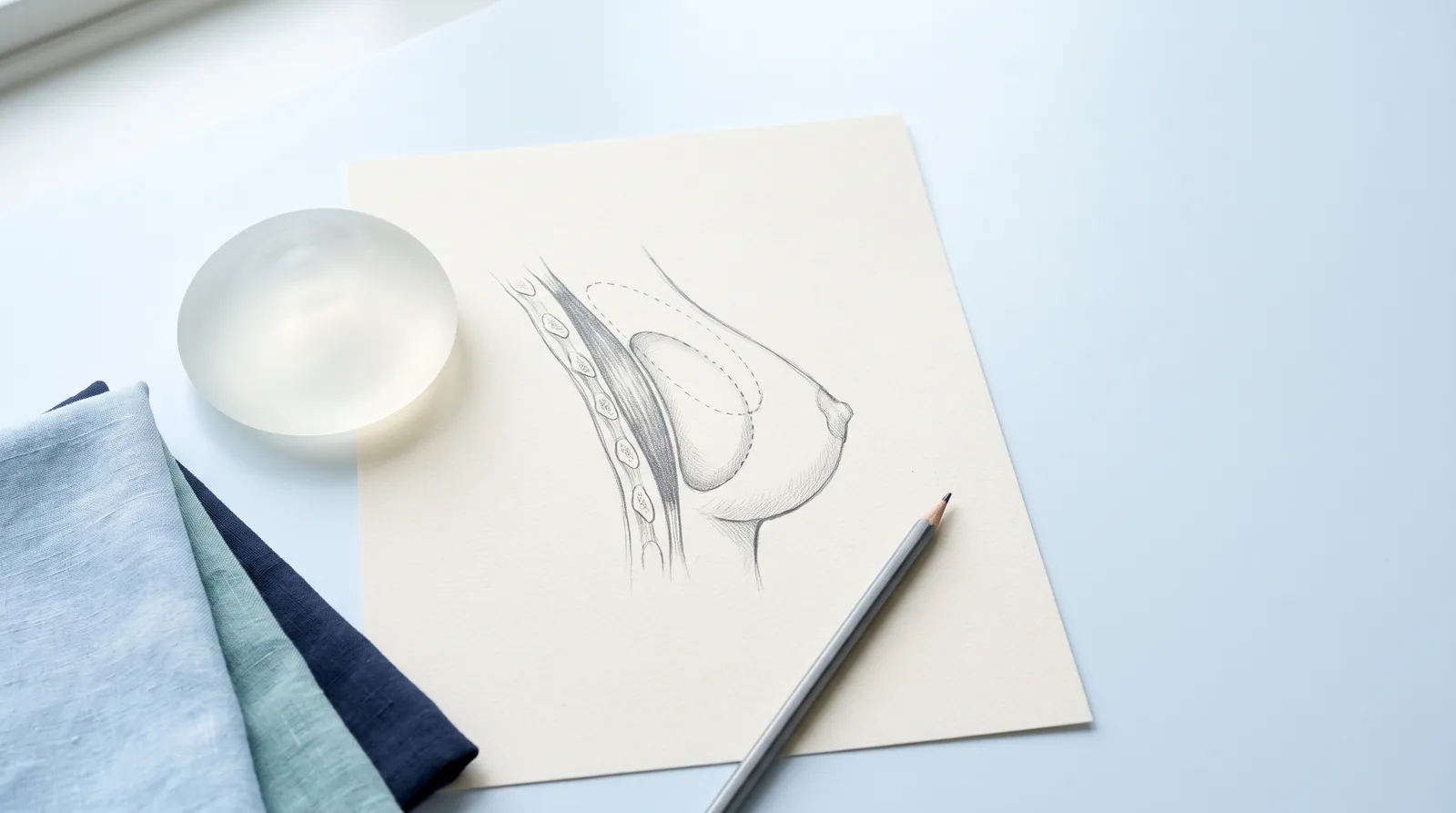
When you're planning a breast augmentation, most of the early attention goes to size and shape. A quieter decision has just as much effect on your result: where the implant sits in your body. Placement changes how the upper breast slopes, how soft the breast feels, whether the implant moves when you flex, and how the first weeks of recovery feel.
There is no single best placement. The right choice depends on how much breast tissue you have, the quality of your skin, your activity level, the implant you choose, and the result you want. This guide explains each option in plain language so you understand why your surgeon might recommend one over another for your anatomy.
The Short Answer
- Over the muscle (subglandular) places the implant directly behind the breast tissue. It can give a fuller upper breast and an easier early recovery. It works best when you already have a good amount of natural tissue to cover the implant.
- Under the muscle (submuscular or dual plane) places some or all of the implant behind the chest muscle. The extra coverage can soften the upper edge of the implant and hide rippling, especially in slim patients. Early recovery is usually more uncomfortable, and the implant may move when you flex.
- Subfascial is a middle option. The implant sits above the muscle but beneath a thin layer of connective tissue that covers it.
The best placement is the one that suits your tissue, your lifestyle, and your goals.
A Quick Anatomy Lesson
It helps to picture the layers of the chest, from the surface inward:
- Skin
- Breast tissue (the gland and the fat around it)
- Fascia, a thin, strong sheet of connective tissue covering the muscle
- Pectoralis major, the large, fan-shaped chest muscle
- The rib cage
Every placement option is a choice about which of these layers sits in front of the implant. More layers usually mean more camouflage. Fewer layers usually mean less interaction with the muscle.
The Four Placement Options
Subglandular (Over the Muscle)
The implant sits between the breast tissue and the chest muscle. The muscle isn't involved at all.
How it looks and feels: Subglandular placement tends to create a rounder, fuller upper pole. The upper pole is the top portion of the breast, above the nipple. Some patients want that fullness. Others find it looks more "augmented" than they'd like. Because only breast tissue and skin cover the implant, the implant's character comes through more directly.
Who it often suits: Patients with a moderate amount of their own breast tissue, patients with mild sagging who want the implant to fill the breast from behind the gland, and patients who want to avoid the implant moving when they flex.
The tradeoff: In slim patients, the edge of the implant can be easier to see or feel, and rippling is more likely to show.
Submuscular (Under the Muscle)
In the strictest sense, a total submuscular pocket places the implant completely behind muscle. This approach is more common in reconstruction than in cosmetic augmentation. When patients say "under the muscle" today, they usually mean the next option, dual plane.
Dual Plane (Partially Under the Muscle)
What is dual plane? In a dual-plane augmentation, the upper portion of the implant sits behind the pectoral muscle. The lower portion sits directly behind the breast tissue. The surgeon releases the lower attachments of the muscle along the crease beneath the breast, so the muscle covers the top of the implant and the bottom of the implant can fill the lower breast naturally.
The name means just that: the implant occupies two planes at once. Surgeons can adjust how far the breast tissue separates from the muscle depending on your anatomy, which is part of why dual plane is such a versatile, widely used technique.
How it looks and feels: The muscle smooths the transition from chest wall to breast at the top. That often gives a gentler, sloping upper pole. Many patients describe this as the more natural profile.
Who it often suits: Slim patients, patients with little upper-breast tissue, and patients who want to minimize visible implant edges or rippling.
The tradeoff: Because the muscle is involved, early recovery is usually sorer, and some patients notice the implant moving when the chest muscle contracts.
Subfascial (Above the Muscle, Under the Fascia)
The implant sits above the muscle but beneath the fascia, the thin connective layer covering the pectoralis. The muscle itself is left intact.
How it looks and feels: Supporters of subfascial placement value the small amount of added support and smoothing that the fascia provides. It avoids involving the muscle. The fascia is thin, though. It adds structure, but it doesn't provide the thick padding that muscle does.
Who it often suits: Patients who would otherwise be good candidates for subglandular placement and want a little extra support, particularly people who are very active and want to avoid flex-related movement.
Comparison Table: Breast Implant Placement Options
| Subglandular | Subfascial | Dual Plane | Total Submuscular | |
|---|---|---|---|---|
| Where the implant sits | Behind breast tissue, above muscle | Above muscle, beneath its fascia | Upper part under muscle, lower part behind breast tissue | Fully behind muscle |
| Upper-pole shape | Fuller, rounder | Fuller, slightly softened edge | Gentler, more sloped | Most softened; can sit higher |
| Tissue coverage | Breast tissue and skin only | Breast tissue, skin, and thin fascia | Muscle on top, breast tissue below | Muscle throughout |
| Visible rippling or edges in slim patients | More likely | Somewhat more likely | Less likely in the upper breast | Least likely |
| Movement when flexing | None from muscle | None from muscle | Possible | Possible, often more noticeable |
| Early soreness | Generally milder | Generally milder | Generally more | Generally the most |
| Often a fit for | Moderate natural tissue, mild sagging | Similar to subglandular; active patients | Slim frames, little upper tissue | Mostly reconstruction |
Every row describes general tendencies. Your own anatomy can change how each option behaves.
Which Looks More Natural?
This is the most common question, and the honest answer is that it depends on what you start with.
For a patient with little breast tissue, dual plane placement often looks more natural. The muscle hides the top edge of the implant and creates a gradual slope. The same implant placed over the muscle on a slim chest can show a visible "step-off" at the top.
For a patient with a healthy amount of natural tissue, subglandular or subfascial placement can look completely natural. It can also shape the breast more effectively when there is mild sagging, because the implant fills the breast directly from behind.
Implant choice matters too. A softer, more elastic implant, or a smaller size relative to your frame, tends to look more natural in any plane. Our breast implant size guide explains how width, projection, and your chest measurements fit together.
Tissue Coverage & Visible Rippling
Rippling refers to wrinkles or folds in the implant shell that can be seen or felt through the skin. It is most often noticed along the sides, the bottom, or the cleavage area, and when leaning forward.
The main factor is how much soft tissue covers the implant. Placing part of the implant beneath muscle adds a layer of camouflage over the upper breast, which is why surgeons often recommend dual plane for thinner patients. Keep in mind that muscle covers only the upper portion in a dual-plane pocket. Rippling can still appear along the lower or outer breast, where only breast tissue and skin cover the implant.
Implant type also plays a role. Silicone gel implants generally ripple less visibly than saline implants. Implants that are very large relative to your tissue can stretch it thin over time. Our guide to breast implant types covers these differences in more detail.
Do Implants Under the Muscle Move When I Flex?
They can. When the implant sits partly or fully under the pectoral muscle, contracting that muscle can squeeze the implant. The breast may visibly shift, flatten, or move upward and outward. This is called animation deformity.
For many patients, the movement is subtle and noticeable only during deliberate flexing or certain exercises. For others, especially those with well-developed chest muscles, it can be more obvious. Implants placed above the muscle, whether subglandular or subfascial, don't have this issue because the muscle doesn't act on the implant.
Animation deformity isn't harmful to your health. Whether it matters comes down to how you live and how you feel about seeing it.
Capsular Contracture in General Terms
After any implant is placed, your body naturally forms a thin layer of scar tissue around it, called a capsule. This is normal and expected. Capsular contracture happens when that capsule tightens and thickens. The breast can then feel firm, look distorted, or in some cases become uncomfortable.
The causes aren't fully understood, and many factors appear to play a part. Low-grade bacterial contamination, bleeding, implant surface, surgical technique, and individual healing all contribute. Many studies have reported lower contracture rates with placement under the muscle than over it. Placement is still only one piece of the picture, and modern implant designs and careful surgical technique have changed the conversation.
Dr. Kapadia will discuss your specific risk factors, and the steps he takes to reduce them, during your consultation.
Which Hurts More? Which Has the Longer Recovery?
Under the muscle usually hurts more at first. When the chest muscle is lifted or released, patients commonly describe tightness, pressure, and soreness, often like an intense chest workout. Placement above the muscle typically feels milder in the early days, because the muscle isn't disturbed.
Recovery in the first stretch is usually longer with muscle involvement. Patients with dual plane or submuscular placement often need a bit more time before they feel comfortable reaching overhead, driving, or returning to upper-body activity.
With muscle placement, the implants also tend to sit high and feel firm at first. They gradually settle into position over the following months as the muscle relaxes. This process is often called "drop and fluff." Above-muscle implants generally settle too, but there is less muscle tension to work through.
Every patient heals differently, and pain control has improved considerably. For a week-by-week look at what to expect, see our breast augmentation recovery timeline.
Mammograms & Imaging
Breast implants of any type and in any placement can partially hide breast tissue on a mammogram. Here is what to know:
- Always tell the imaging center you have implants when scheduling. Technologists use special techniques, often called implant displacement views, that gently move the implant aside to image more of the breast tissue.
- Placement under the muscle may make imaging somewhat easier, because the implant sits behind the muscle rather than directly behind the breast tissue.
- Silicone implants call for periodic imaging for "silent" rupture. These are leaks that cause no symptoms. FDA labeling for silicone gel implants recommends ultrasound or MRI screening, beginning several years after surgery and repeating at intervals. Dr. Kapadia will review the current guidance for your specific implants.
Implants shouldn't stop you from keeping up with routine breast cancer screening.
Which Is Better If I Work Out?
If you lift weights, do CrossFit, practice yoga or Pilates, compete in bodybuilding, or train your chest regularly, discuss placement with your surgeon early.
Considerations that favor above the muscle (subglandular or subfascial):
- No animation deformity during push-ups, bench presses, or other chest-dominant movements
- The pectoral muscle is left intact, which some athletes prefer
- Often a quicker return to comfortable upper-body training
Considerations that favor under the muscle (dual plane):
- Better camouflage for very lean athletes, who often have little body fat and thin breast tissue
- Softer upper-pole contour when there is little natural tissue
Very lean athletes face the hardest tradeoff, because they are the patients most likely to need muscle coverage and most likely to notice flex-related movement. For these patients, a subfascial pocket, a carefully chosen implant size, or a tissue-sparing technique may offer a useful balance.
Whatever the placement, you'll need to wait before returning to heavy lifting and chest work. Dr. Kapadia will guide your return to training step by step.
How Placement Interacts With Implant Type
Placement and implant choice work as a pair. Changing one can change the recommendation for the other.
- Saline implants tend to ripple more visibly, so they often benefit from added muscle coverage, especially in slim patients.
- Silicone gel implants generally feel softer and ripple less, which can make above-muscle placement more realistic for more patients.
- Implant size and width matter in every plane. An implant that is too wide or too heavy for your tissue can stretch it thin over time, whatever the pocket.
Motiva Ergonomix
Motiva Ergonomix is a round silicone implant made with a highly elastic gel. It is designed to move with your body. When you stand, the gel shifts so the breast takes on a more natural, sloped shape. When you lie down, the implant rounds out. Its soft, adaptive feel is one reason surgeons consider it a good match for tissue-sparing approaches.
Which Placement Does Motiva Preservé Use?
Motiva Preservé is a minimally invasive breast augmentation technique built around preserving your natural tissue. It typically places the implant above the pectoral muscle, in a subfascial or subglandular pocket. The implant goes through a small incision into a precisely sized pocket, which leaves the muscle intact. Because the muscle isn't lifted or released, patients often describe a gentler recovery, and there is no flex-related movement.
Preservé is not right for everyone. It is usually a good fit for patients with enough natural tissue to cover the implant, who want a modest, natural-looking enhancement rather than a dramatic change in size. Dr. Kapadia can tell you whether you are a good candidate after examining your tissue.
How Your Existing Breast Tissue & Skin Decide the Recommendation
This is the heart of the decision. In a consultation, your surgeon will evaluate:
- Soft-tissue thickness. Many surgeons gently pinch the tissue above the breast to estimate coverage. When the upper-pole pinch is thin, often less than about two centimeters, surgeons commonly recommend muscle coverage. Thicker tissue gives you more options.
- Skin quality and elasticity. Thin, stretched skin, which is common after pregnancy, breastfeeding, or weight loss, provides less support and camouflage over time.
- Breast position and sagging. Mild sagging can sometimes be improved with an implant placed over the muscle or with certain dual-plane adjustments. More significant sagging may call for a breast lift alongside augmentation.
- Chest wall shape and muscle development. Asymmetry, a prominent rib cage, or very developed pectoral muscles can all shift the recommendation.
- Your goals and lifestyle. How full you want the upper breast, how active you are, and how much flex movement you would accept.
This is why two patients asking for the same look can receive different recommendations. The goal is a result that suits your body and still feels right years from now.
Can Placement Be Changed Later?
Yes. Switching implant placement, often called a plane change or pocket change, is an established revision procedure. Common reasons include:
- Moving from above to below the muscle to improve visible rippling, implant edges, or, in some cases, capsular contracture
- Moving from below to above the muscle to reduce animation deformity, particularly for active patients
Revision surgery is generally more involved than the original procedure. Depending on your tissue, it may require repairing the old pocket, reinforcing the support around the implant, or replacing the implant at the same time. Recovery varies with the complexity of the change.
It is possible, but the best plan is to choose the placement that suits you from the start.
So, Is Over or Under the Muscle Better?
Neither is better for everyone. Each placement solves different problems:
- Choose muscle coverage when you need camouflage: limited tissue, thin skin, or a strong wish to soften the upper edge of the implant.
- Choose above-muscle placement when you have enough tissue and want to avoid flex movement, minimize early soreness, or pursue a tissue-sparing approach like Preservé.
The right answer comes from an in-person exam and an honest conversation about your goals. Learn more about the full procedure on our breast augmentation page.
Plan Your Breast Augmentation With Dr. Kapadia
Sameer Kapadia MD, FACS, is a double board-certified plastic surgeon certified by the American Board of Plastic Surgery. He brings an artist's eye to every breast augmentation. During your consultation, he will examine your tissue, explain which placement options suit your anatomy, and walk you through the tradeoffs so you can make a confident, informed decision. Dr. Kapadia is always in your corner.
We welcome patients from Schaumburg, the Chicago suburbs, and communities across Illinois at both of our offices:
- Elk Grove Village (primary office): 800 Biesterfield Rd
- Chicago, Lakeview: 2845 N Sheridan Rd
Your next chapter awaits. Request your consultation at our Elk Grove Village or Chicago office.
If you are researching this topic and want a personalized recommendation, explore the related procedure and schedule a consultation.