Breast Implant Size Guide: CCs, Profiles, & Proportion
A cc number cannot tell you how an implant will look on your body. This guide explains volume, base width, and profile, and how your anatomy and proportions set the right size range.
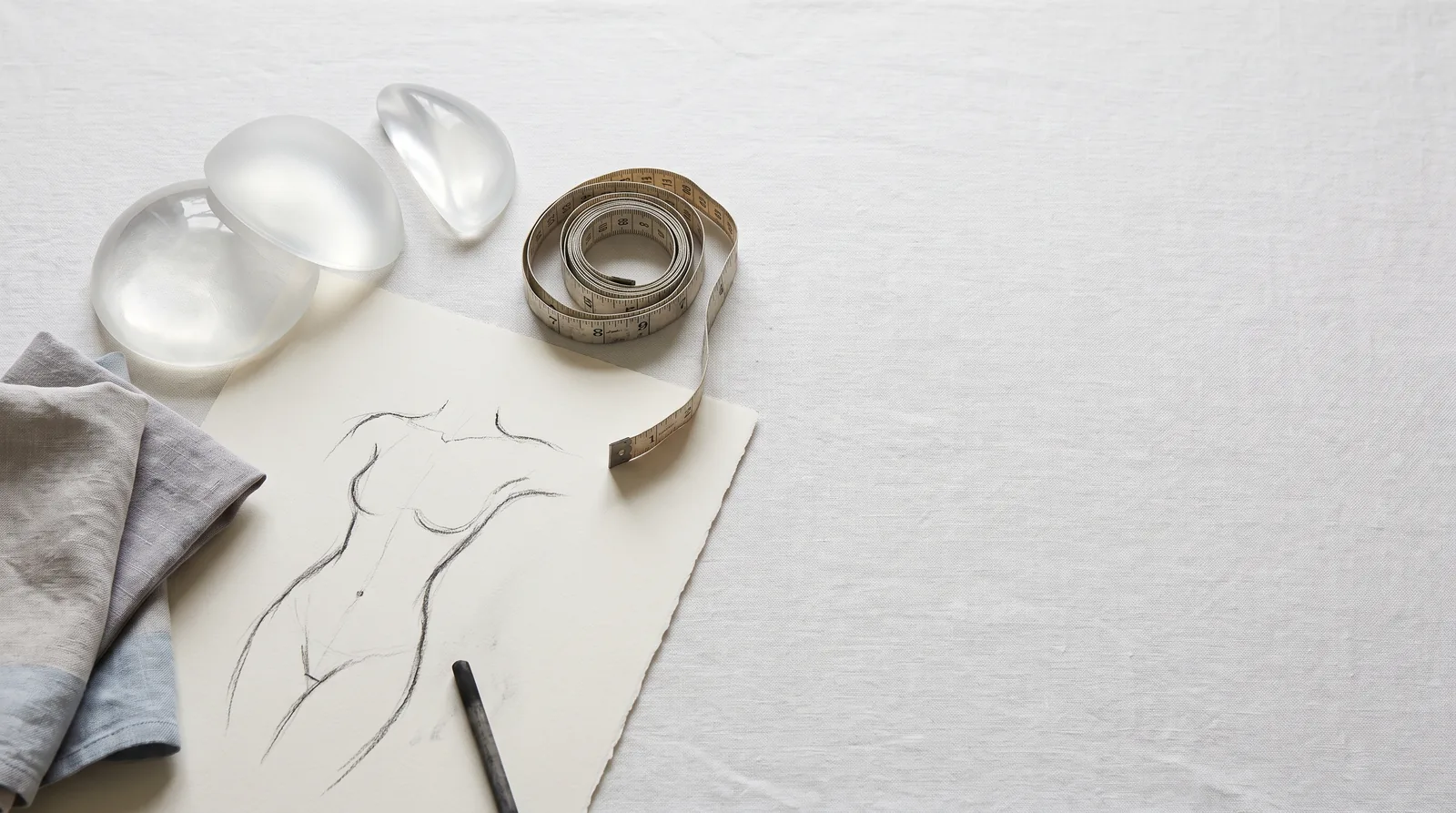
Most people start thinking about implants with a number in mind. Sometimes it's a cup size, like "a full C." Sometimes it's a volume a friend chose, like "400 ccs." Both feel like a reasonable place to begin. Neither one can tell you how an implant will look on your body.
The same 350 cc implant can look modest on one person and dramatic on another. A "D cup" from one bra brand may not fit the same way as a D from another. What actually decides your result is how well the implant's shape and dimensions fit your chest, your tissue, and your overall proportions.
This guide explains how implant size is really chosen: what the numbers mean, where they mislead, and how a proportion-based approach leads to results that look like they belong to you.
What "CC" Actually Means
A cc (cubic centimeter) is a unit of volume, the same as one milliliter. An implant labeled 300 cc holds 300 milliliters of silicone gel or saline. For a sense of scale, about 30 ccs is roughly one fluid ounce.
The cc number tells you how much an implant holds. It tells you nothing about:
- How wide the implant is at its base
- How far it projects forward from your chest
- How it sits on your particular rib cage and tissue
- How much breast tissue you already have covering it
Two implants with the same volume can have very different shapes. One may be wider and flatter; the other narrower and more projecting. On the same patient, they'll create two different looks. That's why volume is one part of the decision, not the whole decision.
How Many CCs Is a Cup Size?
This is one of the most searched questions about breast augmentation, and the honest answer is: there's no reliable conversion.
You'll find charts online that claim a certain number of ccs adds one cup size. They're appealing because they turn a complicated decision into simple math. They don't hold up, though, for several reasons:
- Bra sizes aren't standardized. Cup volume varies from brand to brand, country to country, and even between styles from the same manufacturer.
- Cup size depends on band size. A D cup on a 32 band holds less volume than a D cup on a 38 band. The same implant on two different rib cages lands in different "cup sizes."
- Your starting point changes the outcome. Implants add to the tissue you already have. Someone with more natural breast tissue will see a different change than someone with very little.
- Placement changes the look. An implant placed under the chest muscle looks and measures differently than the same implant placed over it.
- Fit is subjective. Many people wear the wrong bra size to begin with, and preferences for snug or relaxed fit vary.
So when you see a chart that maps ccs to cups, think of it as a rough rule of thumb, not something to plan surgery around. Cup size is something you shop for after surgery. It isn't a surgical target. A surgeon can't measure it in the operating room, and it doesn't predict how your result will look.
What a surgeon can measure are your chest dimensions, tissue thickness, and skin elasticity. Those are the numbers that matter.
Base Width, Projection, & Profile Explained
Once you look past volume, three dimensions describe how an implant will actually look.
Base Width
Base width is how wide the implant is from side to side. In most cases, it's the most important measurement in implant selection. Your chest has a natural width, roughly the span of your existing breast from its outer edge to the edge nearest your breastbone. An implant that matches that width tends to look balanced. An implant that's too wide can push toward your armpit or crowd the center of your chest. One that's too narrow can leave the breast looking oddly separated or underfilled at the sides.
Projection
Projection is how far the implant extends forward from your chest wall. More projection creates more forward fullness and more upper-pole volume (fullness in the top half of the breast).
Profile
Profile describes the relationship between base width and projection. Most traditional round implants come in a range of profiles, often labeled something like:
- Moderate profile: wider base, less projection. A softer, flatter look that often suits a broader chest.
- Full (or moderate-plus) profile: a middle ground with more forward fullness for a given width.
- High profile: narrower base, more projection. It can add volume to a narrow chest without spilling past its edges, but it creates a rounder, more noticeable look.
Exact names and dimensions vary by manufacturer, so one company's "moderate plus" may not match another's. The idea stays the same: for the same volume, a higher profile puts more of that volume forward, and a lower profile spreads it out.
What is implant profile, in plain terms? It's the shape of the implant from the side. Profile, base width, and volume together decide whether the result looks soft and natural or full and round.
Your Anatomy Sets the Safe Range
Before preference enters the conversation, your body sets the boundaries. A careful size consultation starts with measurements, not a wish list.
Chest Width
Your breast base width largely decides which implant widths will fit. This one measurement narrows the options quickly, and it's why two people asking for the same volume may be guided toward different implants.
Existing Breast Tissue
Your own tissue is the cover over the implant. The more natural tissue and soft-tissue thickness you have, the better an implant is camouflaged. That tends to mean less visible edging and less rippling. Patients with very thin tissue usually do best with more conservative sizes, and sometimes with placement under the muscle for extra coverage.
Skin Quality & Elasticity
Skin that has stretched from pregnancy, breastfeeding, or weight change behaves differently from firm, tight skin. Tight skin limits how much volume can fit comfortably without excess pressure. Loose skin may need more volume to fill it, or it may mean a lift deserves a place in the conversation, because adding size to sagging skin can make heaviness worse over time.
Together, these factors create a safe range: a span of implant sizes your tissue can support well over the long term. Choosing within that range protects both your result and your health.
What Looks Natural on Your Frame?
Inside the safe range, the question becomes artistic: what looks proportionate on you?
Sameer Kapadia MD, FACS, brings a fine-arts background to this question. Dr. Kapadia is a double board-certified plastic surgeon, certified by the American Board of Plastic Surgery. He thinks about the breasts the way an artist thinks about a figure: as part of a whole composition, not an isolated feature. His goal is aesthetic balance, a result that fits your body so naturally that people notice you look wonderful without always knowing why.
Several whole-body proportions shape that judgment:
- Height: A volume that looks balanced on a 5'10" frame may look heavy on someone who is 5'1". Taller patients can often carry more volume while still looking natural.
- Shoulder width: Broader shoulders can balance a fuller result. Narrow shoulders usually call for restraint so the chest doesn't look top-heavy.
- Hip width: Many patients want an hourglass silhouette, where the bust visually balances the hips. If your hips are wider, a bit more volume may make your figure look more harmonious. If your hips are narrow, the same volume could throw off the balance.
- Torso length: A shorter torso has less vertical space, so larger implants can make the chest look crowded.
So what size looks natural on your frame? It's the one that works with your height, shoulders, hips, and torso while staying within your tissue's limits. That's rarely the biggest option, and rarely a number you can choose from a chart. To learn more about this philosophy, read our guide to natural breast augmentation in Chicago.
Can You Try Sizes On Before Surgery?
Yes, and you should. Trying sizers at your consultation is one of the most useful parts of the process.
Sizers are implant-shaped inserts you place in a fitted bra, usually a soft sports bra without padding, so you can see how different volumes change your silhouette. Some tips to get the most out of sizing:
- Wear a fitted top. Bring a T-shirt or blouse you wear often. You'll learn more from fabric than from a mirror alone.
- Compare side by side. Try a few volumes in sequence and watch how each one changes your proportions, not just your bust.
- Look at your profile. View yourself from the side and at an angle, not only straight on.
- Treat sizers as approximations. An implant placed beneath tissue, and sometimes beneath muscle, looks a little different from one sitting in a bra. Sizers help you decide on a direction and a range, not an exact final volume.
Sizing works best as a conversation. You share how each option makes you feel, and Dr. Kapadia explains which ones your anatomy can support well. That shared decision is the heart of a breast augmentation consultation at our practice.
How Lifestyle & Exercise Factor In
Your daily life should shape your implant choice as much as your measurements.
- Runners and high-impact athletes often prefer moderate volumes. Larger implants add weight and movement that can be uncomfortable during exercise.
- Weightlifters and people who do a lot of chest work should discuss placement, since implants under the muscle can shift visibly when the chest muscles contract.
- Yoga, Pilates, and stomach sleepers may notice larger, more projecting implants more often in daily movement.
- Professional and wardrobe considerations matter too. Think about how you want to look in work clothes, swimwear, and fitted dresses, not just one outfit.
There's no wrong answer here. The goal is a result that feels comfortable through your actual days, not just in a mirror.
Can Implants Be Too Big for Your Body?
Yes. Implants larger than your tissue can support carry real risks, and some of them only appear years later.
Rippling
When an implant is large relative to the tissue covering it, visible or palpable wrinkles can appear, especially along the sides and lower breast. This is more likely with thin tissue.
Bottoming Out
A heavy implant can stretch the lower breast tissue over time, so the implant settles below the natural breast crease. The nipple can then look like it sits too high, and correcting it requires revision surgery.
Tissue Thinning & Stretching
Constant pressure from an oversized implant can gradually thin the breast tissue and skin. Thinner tissue makes rippling and implant edges more visible and can limit your future options, including going smaller later.
Other Long-Term Effects
Larger implants also tend to bring more sagging over time, more strain on the back and shoulders, and a look that may feel less like your own.
These risks are a major reason a proportion-based approach matters. Size chosen within your tissue's limits tends to age more gracefully.
How Motiva Ergonomix Behaves Differently
Traditional round implants keep a fairly fixed shape. When you stand, the upper and lower halves of the implant hold much the same contour, which can create a rounder upper breast.
Motiva Ergonomix implants are designed to behave differently. Their soft, highly cohesive gel is built to respond to gravity and movement:
- Standing, the gel shifts so more volume settles in the lower half, creating a gentle slope similar to natural breast tissue.
- Lying down, the implant relaxes and spreads, much as natural breasts do.
That responsiveness can make volume decisions feel different. Because the implant moves and softens with your body, some patients feel the result looks more natural than a traditional round implant of similar volume. Motiva's dimensional options also use their own naming, so profile comparisons don't translate one-to-one from traditional implants. The same anatomical principles still apply: base width, tissue coverage, and proportion decide what fits.
If a natural-moving result appeals to you, learn more about our Preserve breast augmentation in Chicago and browse real outcomes in our Motiva Preserve before-and-after guide.
Use Before-and-After Photos the Right Way
Before-and-after photos are among the most useful tools you have, as long as you use them carefully.
- Look for similar body types. Find patients with roughly your height, build, chest width, and starting breast size. A result on someone with a very different frame won't predict yours.
- Focus on proportion, not numbers. If a gallery lists implant volume, treat it as context. A 375 cc result on a taller patient with a wider chest says little about how 375 ccs will look on you.
- Bring favorites to your consultation. Photos of results you love, and results you don't, help communicate your aesthetic goals better than any cup size.
- Notice consistency. A surgeon's gallery should show natural-looking results across many body types.
Explore Dr. Kapadia's results in our before-and-after gallery.
Should You Go Bigger Than You Think?
You may have heard the advice "go bigger than you think, or you'll regret it." Some patients do wish they had chosen more volume. But that advice ignores the other side of the regret equation.
Some reasons people feel this way:
- Swelling settles. Early on, breasts can look larger than they will once healed. As swelling resolves, the final result can feel smaller than the first weeks suggested.
- Your eye adjusts. After living with a new silhouette for a while, it starts to feel normal, and that can create a pull toward "more."
The answer isn't to automatically size up. It's to choose the fullest result your tissue can support well, and no larger. Going beyond that limit trades a short-term wish for long-term risks like rippling, bottoming out, and tissue thinning. Those issues are harder to fix than feeling slightly more modest than you imagined.
Common Regrets & How to Avoid Them
| Regret | How to Avoid It |
|---|---|
| "I chose based on a friend's number." | Choose based on your own measurements and proportions. |
| "I went larger than my tissue could support." | Stay within the safe range your surgeon defines. |
| "I planned around a cup size." | Focus on silhouette and proportion, not bra labels. |
| "It doesn't suit my active lifestyle." | Discuss exercise, work, and daily habits during sizing. |
| "I didn't try sizers in real clothes." | Bring fitted tops and try several volumes. |
| "I didn't look at similar body types." | Compare results from patients with frames like yours. |
What If You Want to Change Size Later?
It's possible. Size-change revision, sometimes called an implant exchange, lets patients go larger or smaller. A few things to know:
- Your tissue has to heal first. Surgeons generally recommend waiting until your result has fully settled, often several months, before judging your size or planning a change.
- Going larger has limits. Your tissue's capacity still applies, and stretched or thin tissue may restrict how much more volume is safe.
- Going smaller can mean extra surgery. If skin has stretched around a larger implant, a lift may be needed to restore shape.
- Implants aren't lifetime devices. Many patients have a future procedure anyway, which can be a chance to reassess.
The best way to avoid needing a size change is to choose carefully the first time.
Choosing Your Size With Dr. Kapadia
Choosing implant size is part science and part art. The science comes from measuring your chest, tissue, and skin. The art is in balancing those limits with your proportions and your idea of a beautiful result. Dr. Kapadia approaches every consultation as a collaboration, and he's always in your corner as you decide what feels right for your body and your life.
We welcome patients from across the Chicago area, including Schaumburg and communities throughout Illinois, at both of our offices:
- Elk Grove Village (primary office): 800 Biesterfield Rd
- Chicago (Lakeview): 2845 N Sheridan Rd
Your next chapter awaits. Schedule your breast augmentation consultation at our Elk Grove Village or Chicago office to try sizers and find the size that's right for you.
If you are researching this topic and want a personalized recommendation, explore the related procedure and schedule a consultation.