Breast Implant Types Explained: Silicone vs. Saline vs. Motiva
Saline, silicone, gummy bear, and Motiva implants each solve a different problem well. This guide compares how they feel, how rupture is detected, the FDA age rules, and how your anatomy guides the choice.
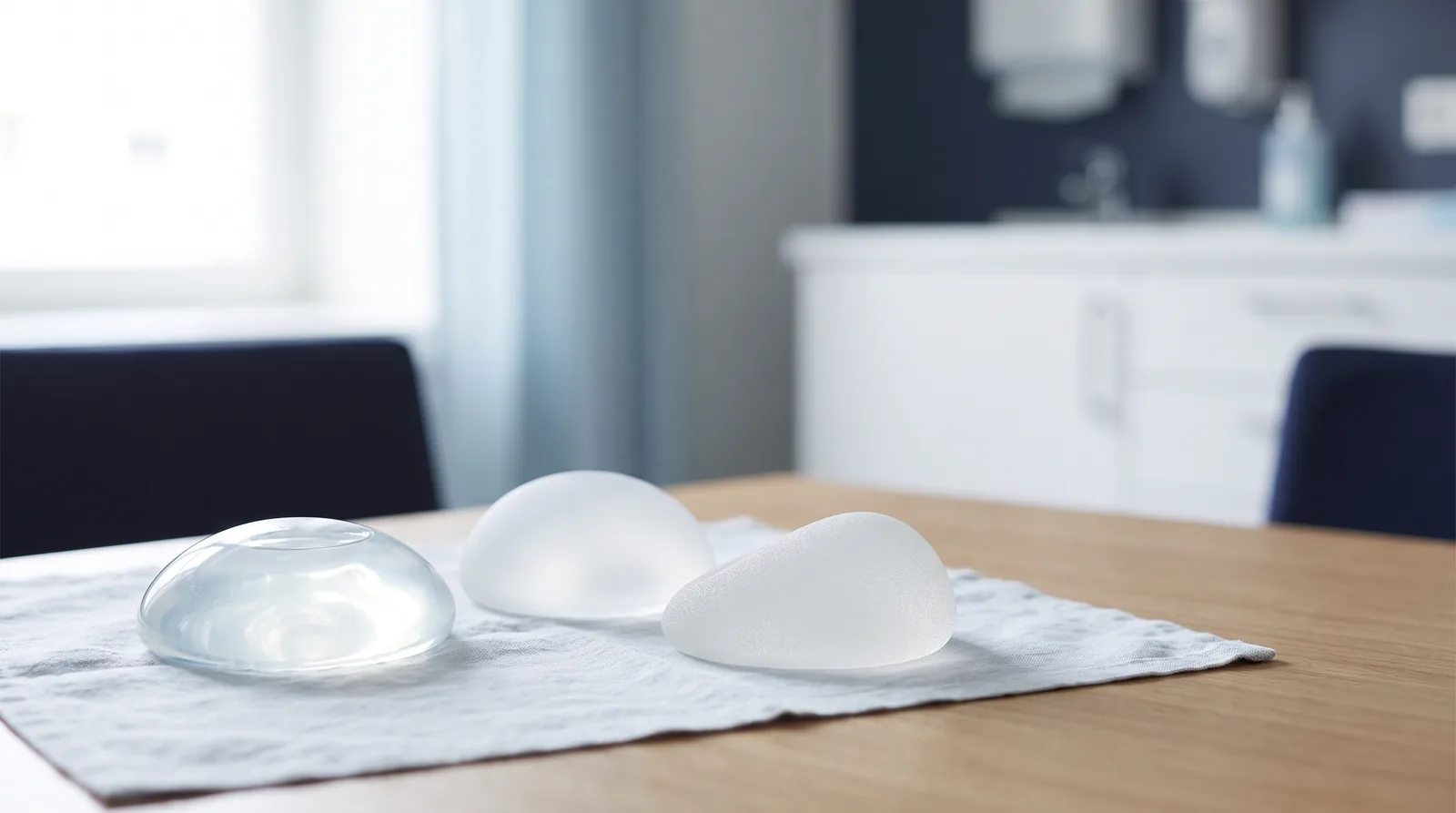
Choosing to have breast augmentation is one decision. Choosing the implant is a separate one, and it can feel harder. Saline, silicone, "gummy bear," and Motiva each have supporters. Online forums often make it sound like one type clearly wins.
None of them wins for everyone. Each implant type exists because it solves a particular problem well. The right one for you depends on your tissue, your frame, how you want to look and feel, and how you plan to look after the implants over time.
This guide explains each option in plain language. It answers the questions patients ask most often in consultations at our Elk Grove Village and Chicago offices.
The Short Answer
- Saline suits patients who want the smallest incision and the lowest implant cost, and who like knowing right away if a rupture happens. It's FDA-approved for cosmetic augmentation from age 18.
- Silicone gel gives the softest, most natural feel for most patients. It's the most common choice today. It's FDA-approved for cosmetic augmentation from age 22 and calls for periodic imaging.
- Highly cohesive ("gummy bear") gel holds its shape best. It's often chosen for a sculpted, teardrop look or for patients with very thin tissue.
- Motiva is a newer silicone gel implant with a smooth, finely textured shell and gel designed to move with your body. It is the implant used in the Preservé technique.
Read on for the details behind each of these.
Saline Implants: Simple, Adjustable, & Easy to Monitor
How They Work
A saline implant is a silicone outer shell filled with sterile salt water. In most cases the shell goes in empty and is filled once it's in position. Because of this, the incision can be quite small. The surgeon can also make small volume adjustments during surgery, which helps when one breast is naturally a little larger than the other.
How They Feel
Saline is firmer and moves more like water than breast tissue does. If you have plenty of your own breast tissue to cover the implant, it can look and feel very natural. If you're slim or have little tissue, you're more likely to see or feel the edges. Visible wrinkling of the implant, called rippling, is also more common, especially along the sides and lower part of the breast.
What Happens if a Saline Implant Ruptures
You'll know. When a saline implant leaks, it deflates over hours to days, and that breast visibly gets smaller. Your body safely absorbs the salt water. The implant still has to be replaced, but there's no question about whether a rupture has happened, and no imaging is needed to find one.
Silicone Gel Implants: The Most Natural Feel for Most Patients
How They Feel
Modern silicone implants are filled with a cohesive gel, meaning the gel holds together instead of flowing like a liquid. It is thicker than the silicone used decades ago. Most patients and surgeons find it closer to natural breast tissue than saline: softer, with less rippling, and with more natural movement.
Cohesiveness, Explained
Silicone gels come in different levels of firmness. Softer gels feel more like natural tissue but keep their shape less firmly. Firmer gels keep their shape better but feel a little firmer. Your surgeon chooses the firmness based on how much tissue you have to cover the implant and the shape you want.
Silent Rupture & Imaging Follow-Up
Silicone implants are pre-filled, so they need a somewhat longer incision than saline. The bigger difference is what happens if the shell breaks. The gel usually stays inside the shell or within the thin layer of scar tissue your body naturally forms around any implant. Often you notice no change at all. This is called a silent rupture.
To catch a silent rupture, the FDA recommends imaging even when you have no symptoms: an ultrasound or MRI starting five to six years after surgery, then every two to three years. Plan for these follow-up scans if you choose silicone.
Highly Cohesive "Gummy Bear" Implants
"Gummy bear" is the everyday name for form-stable silicone implants. Their gel is firm enough to keep its shape even if the shell is cut, much like the candy.
They're often made in a shaped (teardrop) design, with more fullness at the bottom and a gentle slope at the top. This can help patients who:
- Have very thin tissue and want to lower the chance of rippling
- Want a carefully planned, natural-sloping shape
- Are having reconstruction or a revision surgery, where keeping shape matters most
Trade-offs to consider:
- They feel firmer than standard silicone.
- They usually need a longer incision.
- Shaped versions can rotate, which can distort the breast's shape. Most shaped implants have a textured surface to help hold them in place (more on texture below).
Motiva Ergonomix: A Newer Approach to Silicone
What are Motiva implants? Motiva is a line of silicone gel implants made by Establishment Labs. Ergonomix is the Motiva model most often discussed for natural-looking augmentation. Three features set it apart.
1. The shell surface. Motiva uses a surface called SmoothSilk. It is smooth to the touch but has an extremely fine texture, far finer than traditional textured implants. It is designed to work with your body's natural healing response with less of the irritation linked to rougher surfaces.
2. Gel that shifts with position. Ergonomix gel is soft and stretchy, and it moves with gravity. When you're upright, the implant takes on a more teardrop-like slope. When you lie down, it settles into a rounder shape, much as natural breast tissue does. The aim is to get the natural look of a shaped implant without the risk of rotation.
3. The Preservé technique. Preservé is a minimally invasive approach to augmentation designed around Motiva implants. It uses a small incision and a closely fitted pocket made with care to protect surrounding tissue. Patients often choose it hoping for a more comfortable recovery. Learn more about Preservé breast augmentation in Chicago, or read our side-by-side guide on Motiva Preservé vs. traditional breast augmentation.
Motiva isn't automatically the "best" implant. It is a well-designed option that suits many patients who want a soft, natural result. Whether it's right for you still depends on your anatomy.
Round vs. Shaped Implants
Round implants are the same in every direction, so a rotated implant doesn't change how the breast looks. They create fullness in the upper breast. That fullness can be subtle or more noticeable depending on the implant's size, how far it projects, and how soft the gel is. Most augmentations in the United States use round implants.
Shaped implants put more volume in the lower breast for a sloped profile. The result can look very natural, but it depends on the implant staying exactly in place.
There is also a middle ground. A soft round silicone implant often takes on a natural slope once you're standing. Motiva's Ergonomix gel was designed to do this deliberately.
Smooth vs. Textured Surfaces: Why It Matters
This is one of the most important safety topics in implant selection.
Textured implants were developed to grip surrounding tissue, which limits movement and rotation. However, some textured implants have been linked to breast implant-associated anaplastic large cell lymphoma (BIA-ALCL). This is a rare cancer of the immune system that forms in the scar tissue around the implant, not in the breast itself. Most reported cases involve textured surfaces. In 2019 the FDA requested a recall of one manufacturer's textured line, and many surgeons have since moved toward smooth or very finely textured shells.
Smooth implants move more freely within the pocket, so the pocket has to be shaped precisely. In exchange, they avoid the surface feature most closely linked to BIA-ALCL. Ask your surgeon which surface they recommend and why.
Which Implant Is Safest?
No implant is risk-free, and no single type is the "safest" for everyone. Every implant carries some risks: hardening of the scar tissue around it (called capsular contracture), rupture, rippling, a change in position, and eventually the need for another surgery. A small number of patients report symptoms throughout the body that they attribute to their implants, sometimes called breast implant illness. These symptoms are still being studied.
What most affects your safety:
- Your surgeon. Training, board certification, and careful technique influence complications more than the brand of implant.
- The surface. Smooth or very finely textured surfaces have the least association with BIA-ALCL.
- Fit. An implant that suits your tissue and frame causes less strain on your body over the years.
- Follow-up. Staying on top of recommended imaging and check-ups helps catch problems early.
Comparing Feel, Look, Rippling, & Longevity
| Saline | Silicone Gel | Highly Cohesive ("Gummy Bear") | Motiva Ergonomix | |
|---|---|---|---|---|
| Fill | Sterile salt water | Cohesive silicone gel | Firm, form-stable silicone gel | Soft, stretchy silicone gel |
| Feel | Firmer, can feel like water | Soft, close to natural tissue | Firmest of the gels | Very soft, moves with you |
| Shape | Round | Usually round | Often shaped (teardrop) | Round at rest, sloped upright |
| Rippling risk | Highest, especially with thin tissue | Lower | Lowest | Low |
| Incision size | Smallest (filled after placement) | Moderate | Usually longest | Small (especially with Preservé) |
| If it ruptures | Deflates visibly; body absorbs saline | Often silent; found with imaging | Gel holds shape; found with imaging | Often silent; found with imaging |
| Imaging follow-up | Not needed to detect rupture | Ultrasound or MRI recommended | Ultrasound or MRI recommended | Ultrasound or MRI recommended |
| FDA age for cosmetic augmentation | 18+ | 22+ | 22+ | 22+ |
| Relative implant cost | Lowest | Moderate | Higher | Generally highest |
| Surface | Smooth or textured | Smooth or textured | Usually textured if shaped | SmoothSilk (smooth, nano-textured) |
Age Rules for Silicone vs. Saline
For cosmetic augmentation, the FDA approves saline implants for patients 18 and older and silicone gel implants for patients 22 and older. These age limits don't apply to reconstruction after mastectomy or to correcting a congenital difference. Patients between 18 and 21 who want augmentation will usually be offered saline. They can switch to silicone later if they want to.
Do Implants Need to Be Replaced?
Breast implants aren't designed to last a lifetime. There's no fixed expiration date, and many implants last well over a decade. Still, the longer you have implants, the more likely you are to need another surgery at some point. Common reasons include rupture, capsular contracture, changes after pregnancy or weight change, normal aging of the breast, or simply wanting a different size.
If you have no problems and your imaging is clear, you don't need to replace implants just because a certain number of years has passed. Regular check-ups help you and your surgeon decide when, or whether, replacement makes sense.
Which Implant Costs the Most?
In general terms:
- Saline implants cost the least.
- Silicone gel implants cost more.
- Highly cohesive and premium implants, including Motiva, are usually the most expensive.
The implant is only one part of the total fee. Surgeon, anesthesia, and facility fees also apply. With silicone, plan for the cost of follow-up imaging over the years too. Also look at what each manufacturer's warranty covers, since coverage differs. For a full breakdown, see our guide to breast augmentation cost in Chicago.
How Implant Choice Works With Placement & Incision
Your implant, its placement, and the incision work together. Changing one often changes the others.
Placement:
- Under the muscle (submuscular or dual plane): gives more coverage over the implant. This matters most with saline or thin tissue, because it reduces rippling and visible edges.
- Over the muscle (subglandular or subfascial): avoids cutting or lifting the chest muscle and can mean a gentler recovery. It works best for patients with enough natural tissue, and often pairs well with soft silicone or Motiva.
Incision:
- In the crease under the breast (inframammary): the most versatile option. It works for every implant type and gives the surgeon the clearest view.
- Around the edge of the areola (periareolar): the scar blends where the darker skin meets lighter skin. It's best suited to saline or smaller silicone implants.
- In the armpit (transaxillary): leaves no scar on the breast. It's easiest with saline, because larger pre-filled implants are harder to place this way.
Pre-filled gel implants need a longer incision than saline. Firmer, shaped gels usually need the longest.
Which Implant Feels Most Natural?
For most patients, a soft cohesive silicone implant or Motiva Ergonomix feels closest to natural breast tissue. That's especially true with good tissue coverage. Saline can also feel natural for patients with plenty of their own breast tissue. Highly cohesive implants trade some softness for shape control.
Your own tissue matters as much as the implant. The more natural tissue covers the implant, the more natural any implant will feel.
So, Which Is Better: Silicone or Saline?
Neither is better in every case.
Saline may suit you if you're 18 to 21, want the smallest possible incision, prefer the lowest implant cost, or would rather know immediately if a rupture happens without scheduled imaging.
Silicone may suit you if you want the softest, most natural feel, have thinner tissue and want less rippling, and are comfortable with periodic imaging.
Motiva may suit you if you want soft silicone that moves naturally, a smooth surface with a very fine texture, and a minimally invasive approach such as Preservé.
How Dr. Kapadia Matches Implant to Anatomy
Sameer Kapadia MD, FACS, is a double board-certified plastic surgeon, certified by the American Board of Plastic Surgery. He brings a fine-arts background to breast surgery. He doesn't start with an implant. He starts with you.
During your consultation, Dr. Kapadia evaluates:
- Chest width and breast base width, which limit how wide the implant can be
- Tissue thickness and skin quality, which decide how much coverage the implant will have and how soft the gel can be
- Breast shape and position, including whether a lift should be part of the plan
- Natural differences between your two breasts, which may call for different implant sizes or adjustable volume
- Your goals: the look you want, your lifestyle, your comfort with follow-up imaging, and your budget
From there, he recommends an implant type, size, placement, and incision that work together. The goal is impeccably natural results that look like they belong to you. Size is its own decision, and our breast implant size guide walks through how it fits alongside implant type. For a complete overview of the procedure itself, visit our breast augmentation page.
Your Next Chapter Awaits
You don't have to make this decision from a forum thread or a comparison chart alone. Holding implant samples, talking through your priorities, and having your anatomy measured will make the right choice much clearer.
Dr. Kapadia welcomes patients from across Chicagoland, including Schaumburg, the northwest suburbs, the North Side, and communities throughout Illinois. You can meet with him at either office:
- Elk Grove Village (main office): 800 Biesterfield Rd, Elk Grove Village, IL
- Chicago (Lakeview): 2845 N Sheridan Rd, Chicago, IL
We're honored to guide you on your journey. Schedule your consultation and let's find the implant that fits you.
If you are researching this topic and want a personalized recommendation, explore the related procedure and schedule a consultation.