Who Is a Good Candidate for Motiva Preservé Breast Augmentation?
Motiva Preservé suits some patients and not others. This guide explains who tends to be a good fit, who usually needs a different plan, and how candidacy is decided at consultation.
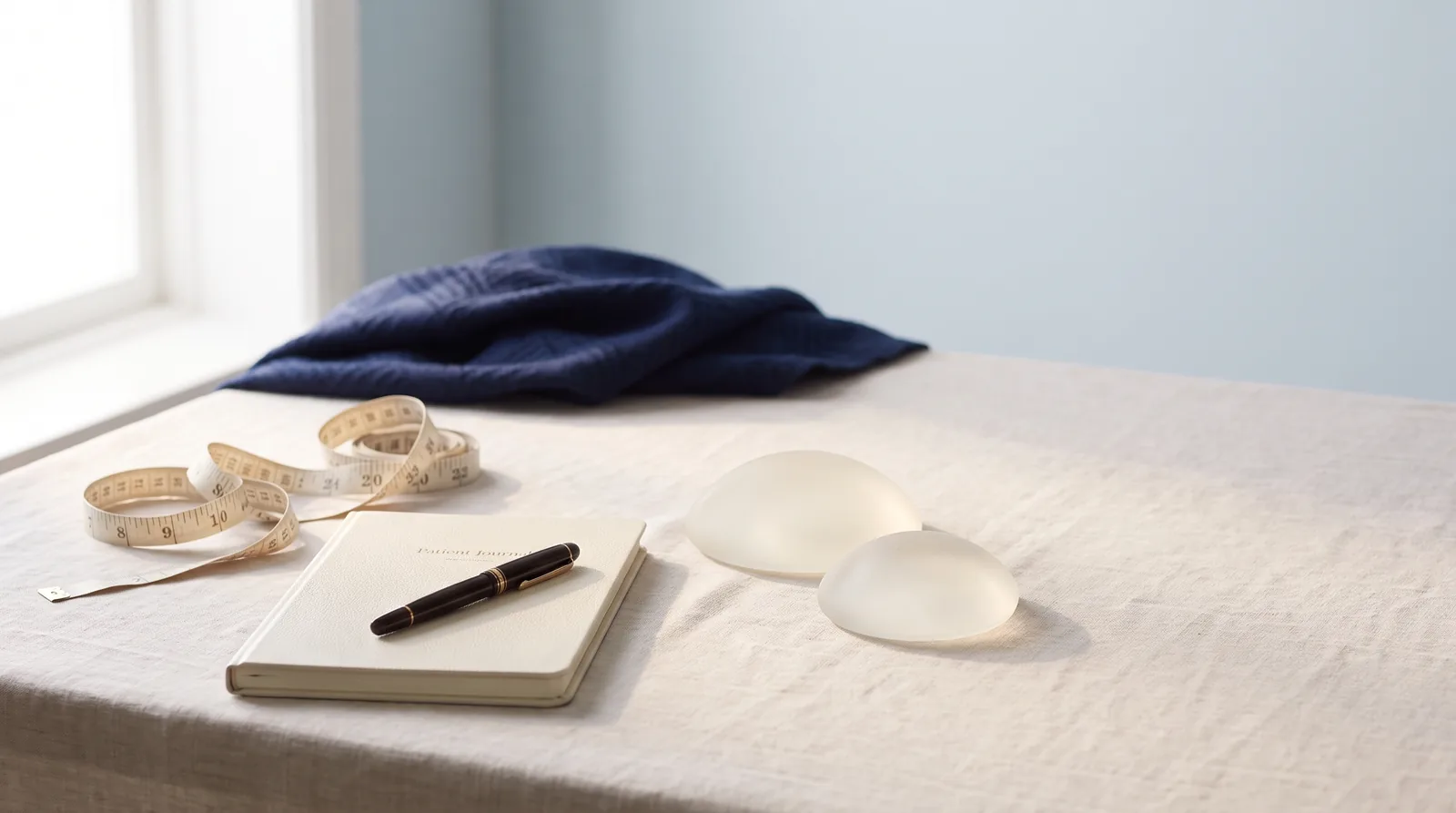
Is Motiva Preservé Right for You? Candidacy Explained
Many patients research Motiva Preservé because they want a small, natural-looking change, and the approach appeals to them. The more useful question is whether it suits your body. Preservé works well for some patients. For others, a different plan will give a better, longer-lasting outcome.
This guide explains who tends to be a good fit, who usually isn't, and how Sameer Kapadia MD, FACS, a double board-certified plastic surgeon, decides at consultation. The goal is an honest picture, not a sales pitch.
Quick Answers
- Am I a candidate? Possibly, if this is your first augmentation, you want a modest to moderate increase, and you have good skin quality and enough natural tissue to cover the implant.
- Who usually isn't? Patients with significant sagging, a goal of very large volume, existing implants, or very thin tissue coverage.
- Can it be paired with a lift? Sometimes. It depends on how much the breast needs to be repositioned.
- What if I'm not a candidate? Traditional augmentation, fat transfer, and a breast lift with implants are all well-established options.
What Is Motiva Preservé?
Motiva Preservé is a breast augmentation approach built around Motiva silicone gel implants. It's designed to preserve as much of your natural breast tissue as possible and to avoid disrupting the chest muscle. The implant goes into a precisely sized pocket through a small incision instead of a larger dissection.
You may also see it written as "Motiva Preserve," without the accent mark. It's the same procedure. For a full overview of how Dr. Kapadia performs it, visit our Motiva Preservé breast augmentation page.
Because the technique is designed to keep tissue intact and work with your existing anatomy, your anatomy has a large say in whether it will look the way you hope.
Who Tends to Be a Good Candidate for Motiva Preservé
No single trait decides candidacy. Good candidates usually share several of these:
First-Time Augmentation
Preservé is designed for breasts that haven't had surgery before. It depends on undisturbed tissue planes, and earlier surgery changes them.
A Goal of Natural-Looking Proportion
The approach suits patients who want their breasts to look like a fuller version of their own: balanced with their frame, soft in shape, and not obviously augmented. If you look through before-and-after photos and are drawn to subtle results, that tells us something useful. You can see examples in our Motiva Preservé before & after guide.
A Modest to Moderate Size Increase
Preservé works with your existing tissue rather than creating a large new pocket, so it suits patients who want a meaningful but measured change.
Good Skin Quality
Healthy, elastic skin drapes evenly over an implant and supports a smooth contour. Skin that has stretched a lot or lost its spring may not give the same result.
Adequate Tissue Coverage
This is one of the most important factors. With an approach designed to leave the chest muscle undisturbed, your own breast tissue and skin do the work of covering and softening the implant. Enough coverage helps the result look and feel natural.
How Chest Width, Breast Tissue, & Skin Elasticity Affect Candidacy
These three measurements often matter more than your goal cup size.
Chest width. Your breast base width, meaning how wide each breast sits on your chest, sets a practical limit on implant width. An implant wider than your natural footprint can look unnatural at the sides or near the breastbone. A narrow chest usually suits a smaller implant, and a broader chest can carry more width.
Existing breast tissue. The breast tissue you already have becomes the implant's cover. Patients with a reasonable amount of tissue, even if they feel "small," often have enough to soften the edges. Patients with very little tissue may see or feel the implant more easily with a placement above the muscle.
Skin elasticity. Elastic skin adjusts well to a moderate increase and holds the implant in a natural position. Loose skin may let the implant settle lower than intended, or it may not hold the shape well. Loose skin is often a sign that a lift needs to be part of the conversation.
Who May Need a Different Plan
Being "not a candidate" for Preservé doesn't mean you can't reach your goals. It means another approach will probably serve you better.
| Your situation | Why Preservé may not be the best fit | What's often discussed instead |
|---|---|---|
| Significant sagging (ptosis) | An implant alone adds volume but doesn't lift the nipple or reshape loose skin | Breast lift, with or without implants |
| A goal of very large volume | Large implants need more coverage and pocket space than the approach is designed for | Traditional augmentation |
| Existing implants (revision) | Earlier surgery has changed the tissue planes Preservé relies on | Revision augmentation planned for your history |
| Very thin tissue coverage | Too little natural tissue to camouflage an implant placed above the muscle | Traditional augmentation with muscle coverage, or fat transfer |
Can Preservé Be Used to Replace My Existing Implants?
Usually not. Implant replacement and revision involve scar tissue (the capsule), a pocket that has already been created, and sometimes changes in position or tissue thickness. Those conditions don't match what Preservé is designed for. Dr. Kapadia will review your earlier operation, implant type, and current anatomy, then recommend a revision plan suited to that history.
How Large Can I Go With Preservé?
There's no universal number. Your limit is set by your chest width, tissue coverage, and skin. Dr. Kapadia aims for a size your body can support naturally over the long term. If your goal is clearly beyond that, he'll tell you honestly and explain options that can reach it.
Motiva Preservé Combined With a Breast Lift
Can I have Preservé if I need a breast lift? In some cases, yes. Preservé can sometimes be combined with a breast lift (mastopexy) when a patient wants more volume and a better position. Our gallery includes Motiva Preservé cases performed alongside a breast lift.
Whether this combination suits you depends on:
- How much lift you need. Mild to moderate sagging may pair well with Preservé. Significant sagging may call for a more extensive lift, which changes the surgical plan.
- Nipple position. Where your nipple sits relative to the breast fold helps determine the lift technique.
- Your volume goals. A lift can reshape and raise existing tissue. Sometimes that alone brings back more fullness than patients expect.
If Preservé isn't the right partner for your lift, a traditional lift with implants may be. Our guide to breast lift with implants covers that option in detail.
Age & Health Requirements
Is there an age requirement? Yes. U.S. labeling for breast implants sets minimum ages for cosmetic augmentation, and silicone implants carry a higher minimum age than saline. Dr. Kapadia will confirm the current requirement for Motiva implants at your consultation. Beyond the legal minimum, he looks for breast development that has stabilized and a decision you've made for yourself.
In general terms, good candidates are also:
- In good overall health, without uncontrolled medical conditions that affect healing
- Nonsmokers, or willing to stop well before and after surgery, since nicotine interferes with blood flow and healing
- At a stable weight, because significant changes later can affect breast shape
- Up to date on breast health screening appropriate for their age and history
- Realistic about results, with an understanding that every body heals differently and no outcome can be guaranteed
Lifestyle Considerations for Athletes & Active Patients
Preservé is designed to avoid disrupting the chest muscle, and that interests runners, lifters, swimmers, yoga practitioners, and others whose routines depend on their upper body. Some active patients prefer placement that leaves the muscle undisturbed because it may reduce the chance of the implant shifting when the chest muscle flexes.
A few honest points:
- Every patient still needs a recovery period. You'll still have activity restrictions after surgery, and returning to training is gradual. How you feel during recovery varies from person to person. Our Motiva Preservé recovery guide explains what to expect and how activity is reintroduced.
- Very lean athletes sometimes have little breast tissue and body fat. That can make tissue coverage the deciding factor.
- Your sport matters. Tell Dr. Kapadia exactly how you train, including heavy pressing, contact sports, or competitive schedules, so he can factor that into placement and sizing.
For a side-by-side look at how this approach differs from conventional placement, read Motiva Preservé vs. traditional breast augmentation.
Candidacy After Pregnancy & Breastfeeding
Can I have Preservé after breastfeeding? Many patients can. Pregnancy and nursing often reduce upper fullness, and a modest augmentation can bring back volume. Timing and anatomy are what matter.
Timing. It's generally best to wait until you've finished breastfeeding and your breasts have settled. Many surgeons recommend waiting several months after weaning so your breast size, shape, and skin can stabilize before your measurements are taken. If you plan more pregnancies, it's usually wise to wait until your family is complete, because future pregnancies can change the result.
Anatomy after pregnancy. Pregnancy affects patients differently:
- If you've mainly lost volume and your skin has kept good elasticity, Preservé may fit well.
- If you've lost volume and have noticeable sagging or stretched skin, a lift, possibly combined with an implant, may be the better recommendation.
Some patients consider breast surgery as part of a broader post-pregnancy plan. Dr. Kapadia can talk through how procedures might be staged or combined safely.
What Happens at a Motiva Preservé Consultation
Your consultation is where general guidelines become a personal answer. Dr. Kapadia takes time to understand both your anatomy and what you hope to feel when the process is complete.
1. Your Goals
Dr. Kapadia will ask what prompted your interest, how you'd describe your ideal result, and what matters most to you, whether that's a natural feel, proportion, clothing fit, or restoring how you looked before pregnancy. Bringing reference photos can help.
2. Your Health History
Expect questions about medical conditions, medications, smoking, past surgeries, pregnancies, breastfeeding plans, and family history of breast disease.
3. Measurements & Physical Examination
Dr. Kapadia evaluates:
- Breast base width and chest wall shape
- The thickness of your soft tissue coverage
- Skin quality and elasticity
- Nipple position and degree of sagging, if any
- Breast symmetry, since most people have some natural asymmetry
4. Sizing
Using your measurements, Dr. Kapadia will guide you through implant sizing within the range your body can support. This is a conversation, not a sales exercise. If your goal and your anatomy don't line up, he'll explain why.
5. A Clear Recommendation
You'll leave knowing whether Preservé is a good fit, whether a lift should be part of the plan, or whether another approach would serve you better. You'll also have the chance to ask about recovery, risks, and next steps.
Patients see Dr. Kapadia at our Elk Grove Village office, our primary location at 800 Biesterfield Rd, or at our Chicago office at 2845 N Sheridan Rd in Lakeview. Many patients travel from Schaumburg, the northwest suburbs, and across Illinois for consultations.
What Are My Options If I'm Not a Candidate?
If Preservé breast augmentation isn't the right fit, you still have excellent options. Each suits different anatomy and goals:
Traditional Breast Augmentation
Placing the implant partially or fully under the chest muscle adds a layer of coverage. That can help patients with thin tissue, and it allows a wider range of implant sizes and profiles. It's often recommended for patients who want more volume or who have very little natural breast tissue.
Fat Transfer to the Breast
Fat transfer uses your own fat, removed by liposuction from an area such as the abdomen or thighs, to add subtle volume without an implant. It suits patients who want a modest increase, have enough donor fat, and prefer to avoid implants. The volume gain is usually limited, and some transferred fat may not survive, so more than one session is sometimes discussed.
Breast Lift With Implants
When sagging is the main concern, a lift repositions the nipple and reshapes the breast, and an implant restores fullness. Learn more in our guide to breast lift with implants.
Breast Lift Alone
Some patients find that raising and reshaping their own tissue gives the youthful contour they want, without an implant.
The Right Procedure Is the One That Fits You
Motiva Preservé can be a thoughtful choice for the right patient: someone having a first augmentation, hoping for natural proportion, and with the tissue and skin quality to support it. It isn't the right answer for everyone, and an honest recommendation sometimes means pointing you toward a different path.
Dr. Kapadia combines his training with an artist's eye for balance. His aim is a result that complements who you are, and he will always be in your corner when the most honest answer is "not this procedure."
Ready to find out if Motiva Preservé is right for you? Schedule your consultation at our Elk Grove Village office or our Chicago office in Lakeview. We serve patients from Schaumburg, the greater Chicago area, and throughout Illinois. You can also browse our before & after gallery to see the range of results Dr. Kapadia has achieved.
This article is for educational purposes only and isn't a substitute for a personal medical evaluation. Individual results vary, and no specific outcome can be guaranteed.
If you are researching this topic and want a personalized recommendation, explore the related procedure and schedule a consultation.